What two years of trialling practice management systems taught me about where client records belong

I spent two years looking for a practice management system that suited my practice.
I never found one.
What I found instead was a myth much of the profession seems to have accepted.
Not all of the profession, to be fair. Plenty of therapists have kept a paper diary, a locked drawer and a spreadsheet on their own laptop, and have managed their admin this way because they weren't willing to hand their clients' details to a company. If that is you, I believe you were right about the principle, and this article is also for you. What you lacked was never judgement or principle. It was tools built to respect them.
- The convenience is in the tools, not the cloud. The software has to handle your notes to be useful. The software provider does not have to hold them.
- Compliance is not safety. A provider's certificates do not move your responsibility, and they did not stop me losing access to my own notes.
- Test any system before you commit. Create a dummy client, find out how to export the record, or ask for your data back. See whether yoru data is complete, and whether you can actually open it or use it outside the software.
Two years of looking
I tried a lot of systems. Each time, the same thing happened. The features I actually wanted weren't there. The features that were there were sometimes nice, but almost always minimal: a diary, a notes box, an invoice template, a client list. Useful, but not much more than I could have built in a spreadsheet, and nothing that justified what I was being asked to pay for it.
And the asking price was odd. Somewhere between £6 and £30 a month. That sounds like nothing, which is the point. It is £72 to £360 a year, every year, for as long as you practise.
The subscription model makes software look inexpensive when it is, in fact, very expensive for what you are actually getting.
So I started asking what I was getting for the money, month after month. Occasionally a feature was improved. Mostly, what I was paying for was storage: somebody else's computer, holding my records, with a form on top.
The question that changed everything
Then I started thinking about UK GDPR, and about what I was typing into these systems: names, contact details, risk information, and session notes for every client. I was exposing all of it, and I asked myself a question I had never thought to ask before. Which of these features actually needs my clients' records on a server in order to work?
I went through them one by one. Diary: no. Invoices: no. Reminders: no, a messaging service needs a number and a time. Supervision log: no. CPD: no. Session notes: no, they can be written and kept on the device in my hand. Contracts: no. Clinical will: no.
I could count one feature, in a couple of systems, that did need an online service: real-time online booking, where a prospective client sees your availability and books a slot. An online booking tool can handle availability and booking details while my session notes stay on my device.
Everything else was software that could run perfectly well on my own devices. I was paying for features that weren't hard to build locally, and handing over client data for features that didn't need it. The idea that convenience requires your clients' records to be kept on a company's servers was a myth, and a large one.
The convenience is in the tools, not the cloud. Having your notes, diary, invoices and supervision in one well-designed place is what saves you time. Keeping them on a company's server is simply where those tools happened to be built. For the way I work, the value was in having those tools together. I wanted that convenience without a monthly subscription or provider-hosted clinical records.
The compliance myth
The myth about convenience is one thing. The myth about compliance is bigger, because it is the one that stops therapists asking the question at all.
More than once I went to open my own records and found I couldn't, because a web service somewhere between me and my data was down. Sitting at my desk, ten minutes before a client, unable to read my own notes, because of an outage at a company I had never heard of and would never get an explanation from.
When I looked at security, I'd been thinking about who could see my notes. The outage made me ask whether I could get to them when I needed them. When your clinical notes depend on a chain of companies all being up at the same time, access to your own practice becomes something that can be taken away.
I think many therapists believe two things: that these systems give you compliance, and that compliance means safety. The first is partly true, with limits I come to below.
The second is not true at all. Compliance DOES NOT EQUAL safety.
Getting my own data back
Every time I trialled a system, I ended by asking for my data. You would think that would be the easy part.
It was astonishing. Large organisations struggled to give me my own records. Some took months. Some could not do it at all. When data did arrive, it came in formats that made importing it anywhere else a project in itself, and more than once the set was incomplete.
Getting a copy and getting a copy I could actually use were two different things.
Where a provider processes client data on your behalf, the contract between you must provide for that data to be returned to you or deleted, at your choice, when the service ends, subject to any legal retention requirement. Read that clause before you sign, and ask what "returned" will look like in practice. Whatever the paperwork says, my experience was plain: once your practice is inside a platform, getting it out is harder than you were ever told.
That is the moment the subscription stops being a fee and becomes a lock.
Two questions that test any feature
1. What information does this feature actually need?
A reminder needs a time and a phone number. A diary needs dates. An invoice needs billing details and a fee. Asking this is the data minimisation principle in UK GDPR applied to software: collect only what the task needs. Most therapists already apply it to their own record-keeping; the question is whether their software does.
2. Who needs to hold that information for it to work?
A question about how the product was designed, not about what the task requires. Almost nobody has been encouraged to ask it.
What each task actually needs
Here is my working week, put through those two questions.
| Task | What information it uses | What an online service would need |
|---|---|---|
| Booking a session | A day, a time and a name | Nothing, unless clients book online. Then the service needs your availability and the booker's contact details |
| Raising an invoice | Billing details and the fee. Clinical notes aren't needed | Nothing. The invoice can be made on the device |
| Sending a reminder | A time and a phone number or email address | An SMS or email service handles the number or address and the message. Nothing clinical |
| Logging supervision | The date, the hours and what you chose to bring | Nothing |
| Recording CPD | The activity, the hours and the evidence | Nothing |
| Writing session notes | The notes themselves | Nothing. They can be written and stored on the device |
| Signing a client contract | The agreement and any signatures needed | No separate signing service is required. The link and the signed agreement are shared through the channel you choose. A signing service, if you use one, holds the document and the signatures. Not your notes |
| Setting up a clinical will | Your client list and your clinical executor's details | Nothing. The file can be kept in storage you control |
| Several people editing one record | A shared, current copy | A service that holds the record for everyone who edits it. Ask what else it holds |
The pattern is difficult to ignore. Invoices don't need clinical notes. Supervision logs don't need clinical notes. CPD records don't need clinical notes. Clinical will planning doesn't need clinical notes. Even the notes themselves don't inherently require a provider to store them.
Once you separate the task from the software design, a different question appears.
How much client data is being held because it is necessary, and how much because the platform was built that way, with a subscription attached?
What the rules actually ask of you
UK GDPR requires security, accountability and appropriate access to records. It does not require cloud storage. It does not require a third-party practice management platform. It requires you, as the data controller, to understand and justify whatever system you use. The three obligations therapists tend to bundle together are worth taking one at a time.
Outsourcing storage is not outsourcing responsibility.
Uploading client records to a provider removes none of your obligations. It simply adds another organisation to them.
So I'm building it
Once you separate convenience from centralised storage, the real question is no longer cloud or no cloud? It is: where should the most sensitive information in your practice be kept? I had my answer, and I couldn't buy it. So for the last six months I have been building it, working with developers to make the system I wanted to use in my own practice.
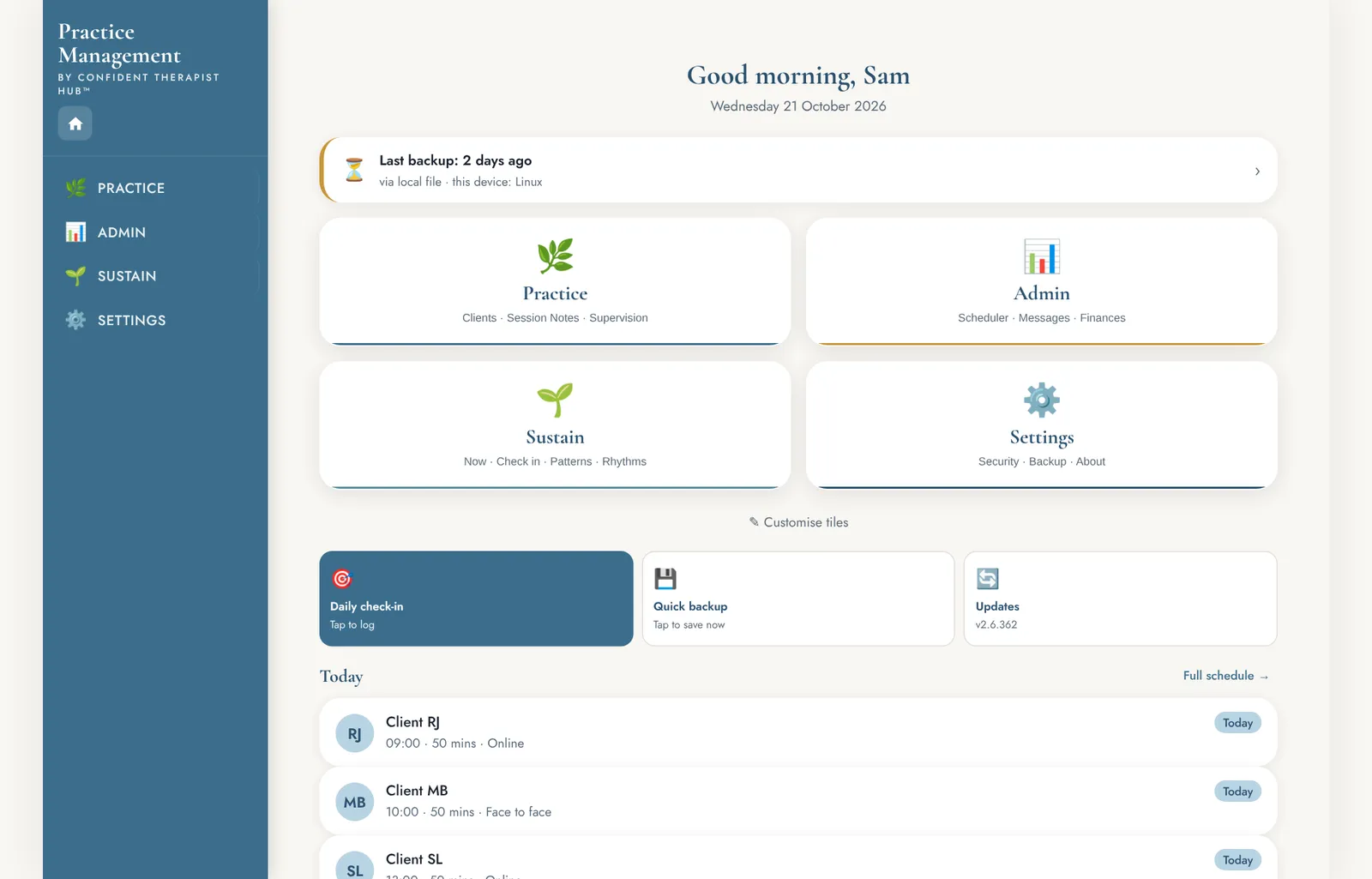
A whole practice on your own phone, tablet and computer. Your client records stay on your devices and in any backup location you choose. A few of the things it does:
- Book a client, write the note, flag it for supervision. When you sit down with your supervisor, the agenda is already written from what you flagged, and the hours log themselves afterwards.
- The session ends, the invoice is ready. Name, fee and date filled in from the client record, as a PDF, with a template message if it goes unpaid.
- Send a contract as a link. Your client signs it on their own device, through whatever channel you already use. No signing service, no account for them to create.
- Twelve recognised outcome measures, scored and charted over time, each score tied to the session it came from.
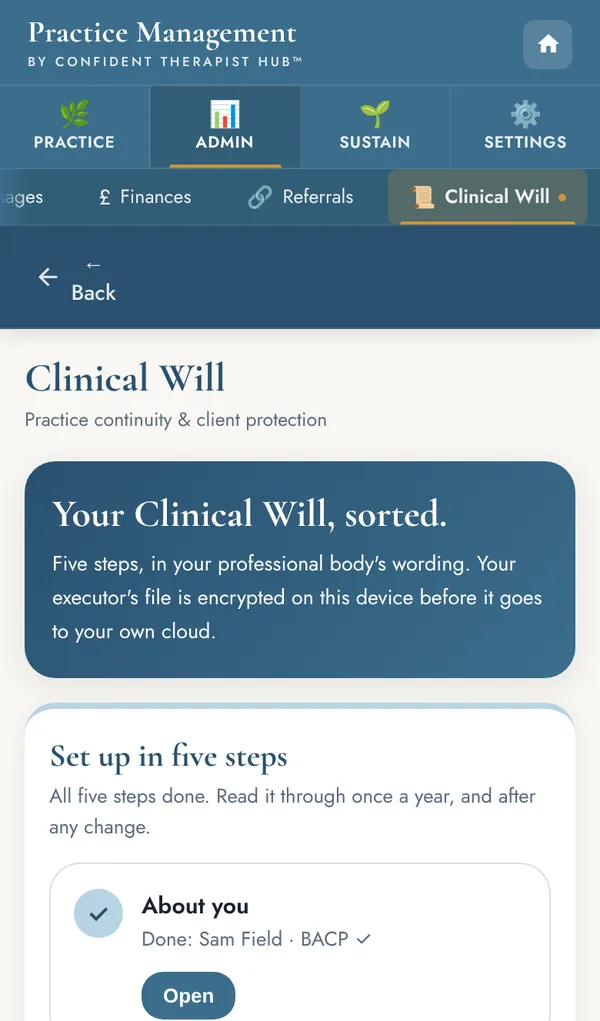
- Clinical will. When you add a client, the app updates the contact list prepared for your clinical executor. You can share a separate encrypted copy containing only what they need to contact clients.
- A check-in for you, not just your practice. A daily energy log that turns into patterns you can see, and a burnout reflection across the recognised domains.
- Your diary opens whether or not the internet does. Your diary, notes, contracts and invoices are on the device, so you can open them without a connection. No outage at a company you have never heard of can stand between you and your next client.
- Locked, encrypted, backed up. A PIN to open the app, records encrypted on the device, and a backup encrypted with a password only you hold before it goes to your own Dropbox, Google Drive, or another location or device you choose. Lose the phone and you restore to a new one.
Paid for once, the way you would pay for any tool. CTH does not receive or store your client records. Purchase, licensing and support run through their own channels, set out in the privacy notice, and none of them involves your clients’ data. Because we do not process client data on your behalf, there is no data processing agreement to sign with us.
Signing a contract, without a signing service
In Clinical Will, our second private app, the executor agreement is a link. You send it to your clinical executor however you already talk to them, by email, WhatsApp or anything else. They open it on their own device and sign. There is no separate signing service, and CTH does not receive the agreement or the signature. You choose how the link is sent and how the signed agreement comes back. Practice Management, our third app and the one now in development, does the same for client contracts.
What changes is who holds a copy of your records and who can access it. With a hosted copy, who can access it depends on how the service handles permissions and encryption. On your own device, it is you. The responsibilities stay the same, and with an on-device setup you also need a backup you can restore. Our apps do this automatically.
If you kept your records private all along, this was built so you no longer have to choose between that and the time software can save you on admin.
You stuck to your principles and your instincts. Private-only software may finally give you the option you deserve.
Five questions to ask any practice software
Whichever system you are considering, including mine, these are the questions I wish I had asked two years ago. Tick each one you can answer. Your ticks aren't saved.
Then test it. Before you commit, create a dummy client with a few notes, a contract and an invoice attached, export the record and check what you can open outside the app. Then ask for your data back, and see how long it takes and how complete it is.
Therapists hold sensitive client data. Before uploading that information anywhere, ask one question: does this feature actually need my clients' records to leave my control?
You may be surprised how often the answer is no. I was.
Where this is going
Practice Management by CTH is in final development. You can see the screens, read how it handles your records and join the founder waitlist there.
Related reading:
- Your notes don’t have to leave the room: the apps that keep notes and dictation on your own device, and what you still have to do to secure, back up and explain them.
- Notes retention and clinical will: two different jobs: how long to keep notes is one decision; who acts if you can’t is another.
- Clinical wills: six key questions to ask: testing any arrangement against the day it is needed, including what happens if the provider isn’t there.
References and sources
- ICO, Data minimisation, UK GDPR data protection principles: https://ico.org.uk/for-organisations/uk-gdpr-guidance-and-resources/data-protection-principles/a-guide-to-the-data-protection-principles/data-minimisation/
- ICO, What needs to be included in the contract between controller and processor: https://ico.org.uk/for-organisations/uk-gdpr-guidance-and-resources/accountability-and-governance/contracts-and-liabilities-between-controllers-and-processors-multi/what-needs-to-be-included-in-the-contract/
- ICO, Responsibilities and liabilities for controllers using a processor: https://ico.org.uk/for-organisations/uk-gdpr-guidance-and-resources/accountability-and-governance/contracts-and-liabilities-between-controllers-and-processors-multi/responsibilities-and-liabilities-for-controllers-using-a-processor/
- BACP, Ethical Framework for the Counselling Professions 2026, sections 2.1(e), 3.2 and 4.5(e), effective from 3 November 2026: https://www.bacp.co.uk/ethical-framework (PDF: bacp-ethical-framework-for-the-counselling-professions-2026.pdf)
Professional body requirements are revised periodically. Check your own body's current wording before acting.
This article is general professional guidance, not legal advice. Data protection and professional obligations depend on your own arrangements, so take advice from your supervisor, your professional body, your indemnity insurer and, where relevant, a qualified data protection adviser.
ICO guidance and framework references checked on 8 November 2026.
© 2026 Confident Therapist Hub Limited. All rights reserved.